Description


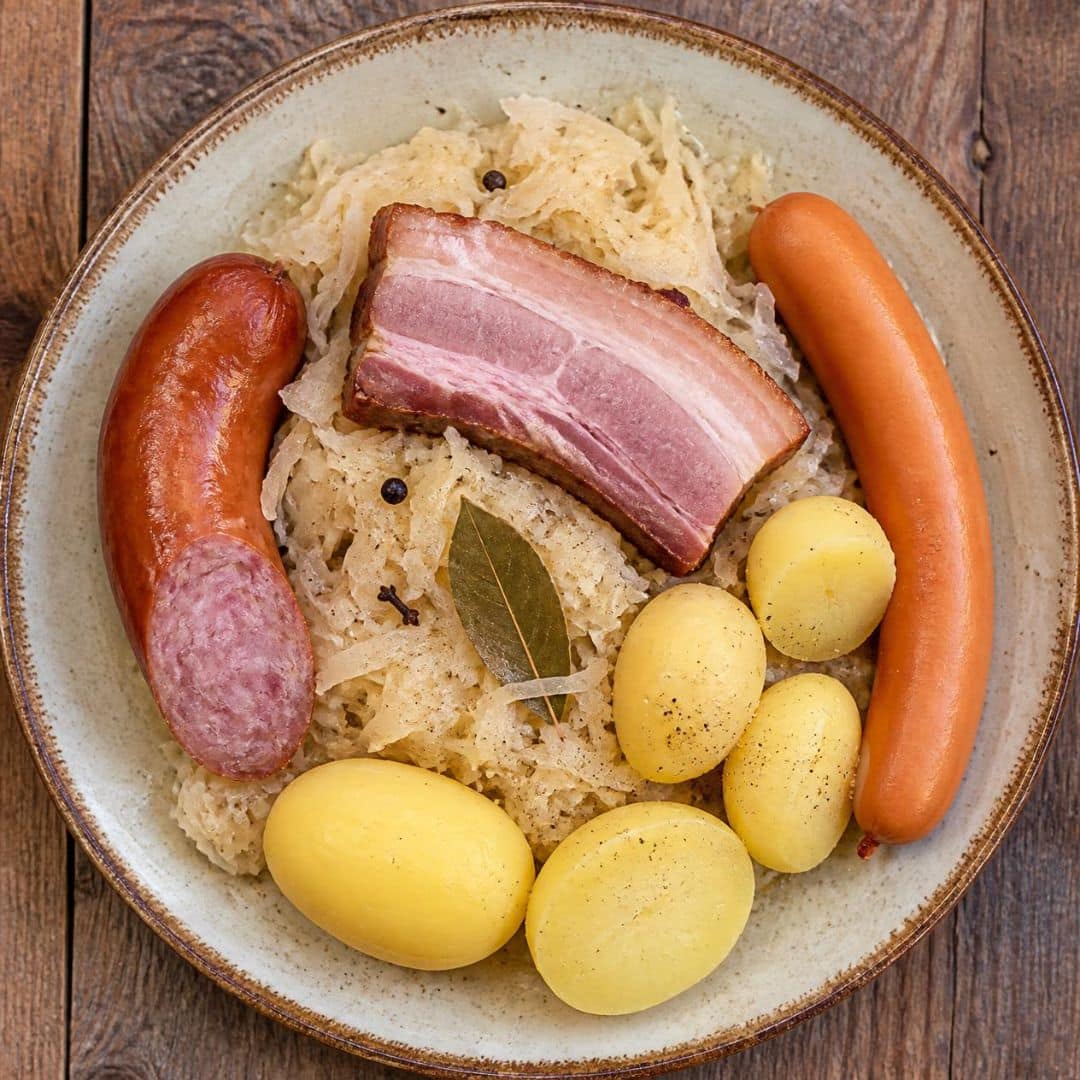
A comforting Alsatian classic: slow-cooked sauerkraut, smoked bacon, Vaud sausage, and Vienna sausage, served with melt-in-your-mouth potatoes. A hearty and flavorful dish, perfect for chilly days.
High in protein – 💪Fit Meal
- At least25 gramsof protein per serving and a maximum of680 calories
Low-carb – 🥦 Low Carb
- 38 grams of carbohydrates or less per serving
Ingredients
Sauerkraut, Vaud sausage, Vienna sausage, smoked bacon, potatoes, onions, organic vegetable broth, white wine, salt, juniper berries, cloves, bay leaves, pepper
Nutritional Information – Per 450-gram serving
| Energy, calories | 617 kcal |
| Proteins | 29.1 g |
| Carbohydrates, available | 17.3 g |
| Lipids | 45.2 g |
| Fatty acids, saturated | 17.4 g |
| Dietary Fiber | 6.2g |
| Salt | 7 g |
Allergens
- Milk (and lactose)
- Gluten
Preparation
| ⏲️ 4 minutes in the microwave Our containers are microwave-safe |
🥘12 minutes in a conventional oven Transfer to a suitable baking dish |
🍳8 minutes in a frying pan Simply reheat in a frying pan |
Which portion should I choose?
Our meals are available in three sizes: 350 g, 450 g, and 600 g.
To help you find the right combination, here are a few examples:
- Normal appetite → 1 × 450 g
- Small appetite → 1 × 350 g
- 2 children → 1 × 600 g to share
- Exercise or a busy day → 1 × 600 g
👉 For a family of four, if you combine 1 x 450 + 1 x 350 + 1 x 600 to share, expect to pay about CHF 14.50 per person. No cooking required!
Give it a try and see what works best for you.
Nutritional Profile — Sauerkraut with Toppings
🧅 Onion (15 g)
Onions provide the aromatic foundation of sauerkraut, brought out by slow cooking in butter. They weigh only 15 grams in this dish but contribute to its high fiber content, providing 0.27 grams per serving. They are a modest ingredient by weight but essential to the flavor.
🥬 Raw sauerkraut (200g)
Fermented cabbage is the signature ingredient of this traditional Alsatian dish. With 4.4 g of fiber per 200 g, it contributes significantly to the meal’s fiber content. Its fermentation also gives it a high natural salt content (2.8 g), which should be factored into the total. It is also a low-calorie vegetable (38 kcal per 200g).
🍷 White wine (18 g)
Used in small quantities to deglaze and flavor the sauerkraut during cooking, the white wine mostly evaporates as it cooks. It contributes only 12.6 kcal to this serving, which has a negligible impact on the dish’s overall nutritional profile.
🥩 Smoked bacon (30g)
Smoked bacon adds fat and a distinctive smoky flavor to choucroute garnie. It contains 96.6 kcal and 8.3 g of fat per 30 g, making it one of the dish’s most energy-dense ingredients. That is why it is used in measured amounts rather than as a whole piece.
🌭 Vaud sausage (75g)
The star charcuterie item in this dish, the Vaud sausage, is the main source of protein (12.4 g) and fat (24.2 g) in the recipe. It alone accounts for more than 40% of the dish’s total calories. However, it remains low in carbohydrates (0.15 g), which is typical of charcuterie.
🌭 Vienna sausage (50 g)
The second type of cold cut in the dish, the Vienna sausage, provides 121 kcal and 7 g of protein per 50 g. Its texture, which is finer than that of the Vaud sausage, makes it a welcome addition to the dish without further increasing its salt content.
🥔 Firm-fleshed potatoes (75g)
Potatoes provide most of the dish's carbohydrates (11.7 g), with a moderate calorie content of 57 kcal. They also provide 1.6 g of fiber, helping to balance the meal along with the sauerkraut.