Description


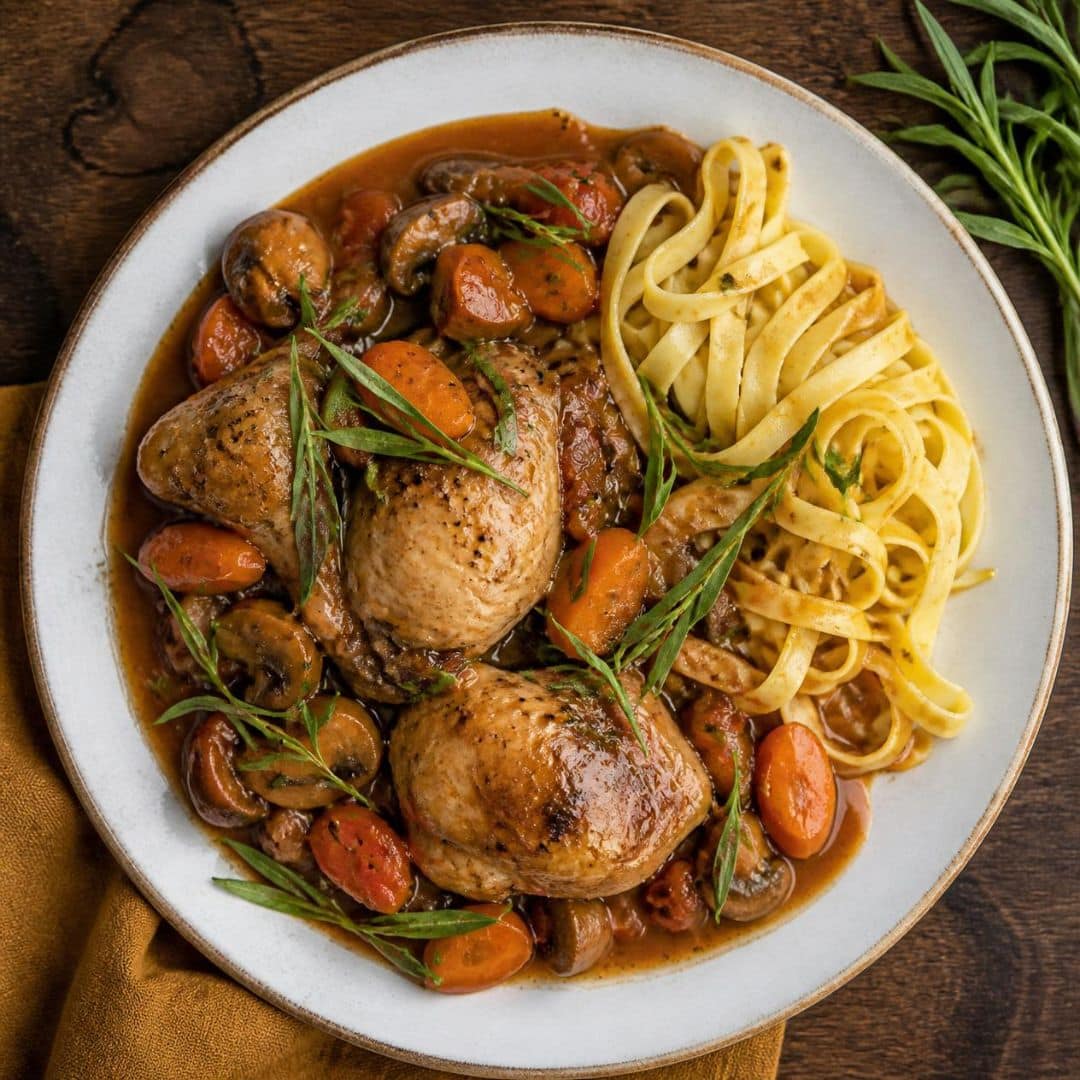
🍗 Chicken chasseur, slowly simmered in a sauce made with mushrooms, port, and red wine, served with tagliatelle and tender carrots. A comforting dish that’s high in protein and fiber.
High in protein – 💪Fit Meal
- At least25 gramsof protein per serving and a maximum of680 calories
Ingredients
Sliced chicken (Swiss), organic beef broth, egg tagliatelle, button mushrooms, oyster mushrooms, carrots, onions, tomatoes, port, red wine, flour, butter, porcini mushrooms, olive oil, garlic, tarragon, salt, pepper
Nutritional Information – Per 450-gram serving
| Energy, calories | 614 kcal |
| Proteins | 41.6 g |
| Carbohydrates, available | 52.9 g |
| Lipids | 20.6 g |
| Fatty acids, saturated | 7.6 g |
| Dietary Fiber | 10.5 g |
| Salt | 2 g |
Allergens
- Milk (and lactose)
- Gluten
- Egg
Preparation
| ⏲️ 4 minutes in the microwave Our containers are microwave-safe |
🥘12 minutes in a conventional oven Transfer to a suitable baking dish |
🍳8 minutes in a frying pan Simply reheat in a frying pan |
Which portion should I choose?
Our meals are available in three sizes: 350 g, 450 g, and 600 g.
To help you find the right combination, here are a few examples:
- Normal appetite → 1 × 450 g
- Small appetite → 1 × 350 g
- 2 children → 1 × 600 g to share
- Exercise or a busy day → 1 × 600 g
👉 For a family of four, if you combine 1 x 450 + 1 x 350 + 1 x 600 to share, expect to pay about CHF 14.50 per person. No cooking required!
Give it a try and see what works best for you.
Nutritional Profile – Chicken Chasseur
🍗 Chicken — 140g
Chicken is the main source of protein in this dish, providing 27.6 g of complete protein per 189 kcal. This clearly places the dish in the “high-protein” category as defined by regulations (>20% of calories).
🍄 Mushrooms (white + oyster) — 112g
Together, these two varieties of mushrooms provide 35.2 g of cooked mushrooms for just 35 kcal, while contributing 4.65 g of fiber—more than half of the dish’s total fiber content. Furthermore, oyster mushrooms are particularly known for their beta-glucan content, a type of soluble fiber associated with beneficial effects on cholesterol levels. That’s why including both varieties enhances both the nutritional value and the umami flavor of the sauce.
🥕 Carrot — 50g
Carrots provide 20 kcal, 1.35 g of fiber, and a significant amount of beta-carotene, which is better released when heated and in the presence of fat (in this case, the butter in the sauce). Furthermore, their natural sweetness balances the bitterness of red wine and the acidity of tomatoes. That is why they are a natural fit for slow-cooked French dishes.
🧅 Onion — 30g
Onions provide 12.9 kcal and serve as the aromatic base of the sauce. Notably, they are rich in quercetin, a polyphenol with antioxidant properties, whose bioavailability is enhanced by cooking. However, their direct nutritional value is modest—it is primarily their role in contributing to the sauce’s flavor and texture that justifies their inclusion.
🍅 Tomato — 25g
A small amount of tomato (25 g) acts as a natural acidifier and colorant in the sauce. It provides lycopene, an antioxidant whose absorption is enhanced by cooking. Its caloric contribution is negligible (6.5 kcal).
🍷 Port + Red Wine — 32 g total
Alcohol evaporates almost entirely during prolonged cooking, leaving mainly tannins (red wine) and residual sugars (port, 1.92 g of carbohydrates). Their final nutritional contribution is estimated at less than 15 actual kcal. This is why they are not considered a significant source of calories but are essential to the sauce’s texture.
🍝 Tagliatelle — 15 g (dry)
The tagliatelle (dry weight) provides 53 kcal and 10.6 g of carbohydrates—the only significant source of carbohydrates in the dish, along with the flour. Furthermore, cooking them separately in salted water allows you to control their texture before adding them to the dish. That is why they serve as a balancing side dish without weighing down the overall nutritional profile.
🧈 Butter — 8 g
Butter is the main added fat (3.94 g of saturated fat per 8 g), used as a base for the sauce and for searing. It also helps give the sauce its richness and bind it together. However, its saturated fat content remains moderate when considered relative to the total serving size (7.5 g per 450 g).