Description


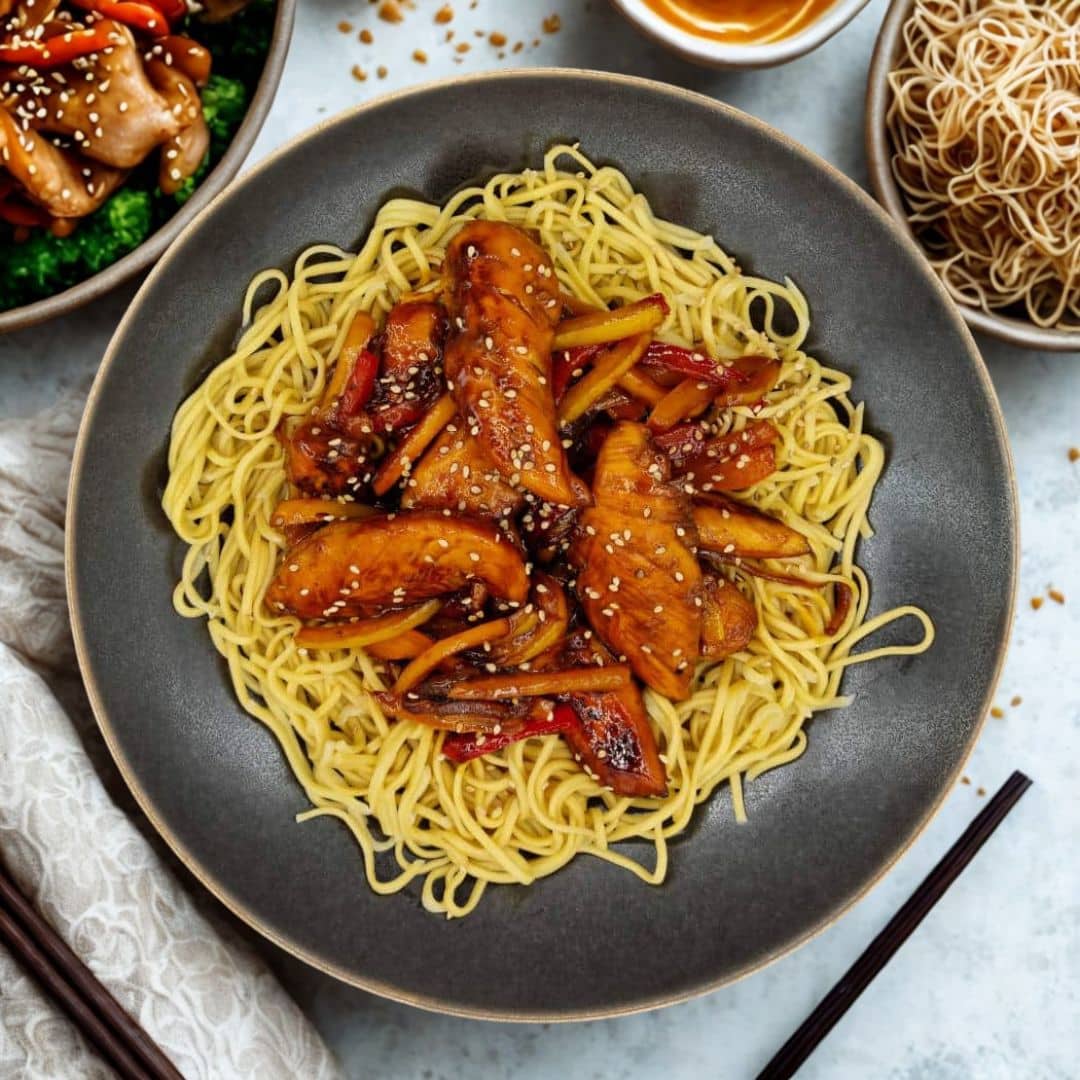
🍗✨ Treat yourself to our deliciously glazed teriyaki chicken, served with crisp sautéed vegetables and light Chinese noodles. A flavorful combination that balances nutrition and enjoyment—perfect for a light, indulgent meal. 🥢🌱
High in protein – 💪Fit Meal
- At least25 gramsof protein per serving and a maximum of680 calories
Low in fat – 🩵 Low Fat
- 10 g of fat or less per serving, with 30% or less of total calories coming from fat
Ingredients
Chicken (Swiss), wheat noodles, bell pepper, red onion, soy sauce, mirin, sake, sugar, honey, orange, canola oil, ginger, sesame seeds, cornstarch
Nutritional Information – Per 450-gram serving
| Energy, calories | 634.6kcal |
| Proteins | 49.2g |
| Carbohydrates, available | 90.3g |
| Lipids | 2.3g |
| Fatty acids, saturated | 0.7 g |
| Dietary Fiber | 6.7 g |
| Salt | 2.2 g |
Allergens
- Gluten
- Soybeans
- Sesame seeds
Preparation
| ⏲️ 4 minutes in the microwave Ourcontainers are microwave-safe |
🥘12 minutes in a conventional oven Transfer to a suitable baking dish |
🍳8 minutes in a frying pan Simply reheat in a frying pan |
Which portion should I choose?
Our meals are available in three sizes: 350 g, 450 g, and 600 g.
To help you find the right combination, here are a few examples:
- Normal appetite → 1 × 450 g
- Small appetite → 1 × 350 g
- 2 children → 1 × 600 g to share
- Exercise or a busy day → 1 × 600 g
👉 For a family of four, if you combine 1 x 450 + 1 x 350 + 1 x 600 to share, expect to pay about CHF 14.50 per person. No cooking required!
Give it a try and see what works best for you.
Nutritional Profile – Teriyaki Chicken, Sautéed Vegetables, and Chinese Noodles – 💪🩵
🍗 Swiss chicken breast — 150g
Chicken breast is the main source of protein in this dish, with 36.9 g of protein and only 1.5 g of fat—an exceptional ratio that ranks this dish among the highest-protein options in the Weekly Food catalog. As a result, one serving covers nearly 90% of an active adult’s daily protein needs (55 g reference). The soy sauce marinade tenderizes the muscle fibers while deeply infusing them with umami flavors before cooking. Furthermore, the Swiss chicken guarantees local traceability and strict farming standards.
🍜 Wheat noodles — 80 g (dry)
Wheat noodles provide the dish’s primary source of energy, contributing 56.4 g of complex carbohydrates and 4.1 g of fiber per 80 g (dry weight)—which accounts for most of the carbohydrates in the serving. They also provide 10 g of plant-based protein, which, when combined with the protein from the chicken, brings the total to 49 g per serving. Furthermore, their soft texture absorbs the teriyaki sauce, creating a cohesive and satisfying taste experience. However, their glycemic index is moderated by the high protein content of the dish as a whole.
🫑 Bell pepper — 100 g
Bell peppers are the main vegetable in this dish, providing 32 kcal and 2 g of fiber per 100 g. They are notably one of the richest sources of vitamin C among common vegetables—red bell peppers contain more vitamin C than oranges on a weight-for-weight basis. In addition, their carotenoids (beta-carotene, lutein) contribute to the dish’s antioxidant profile. Quick stir-frying in a wok preserves these micronutrients, which are sensitive to prolonged heat.
🍶 Mirin — 30g
Mirin is the traditional sweetener in teriyaki sauce: it provides 13 grams of carbohydrates and a distinctive sweetness that balances the umami flavor of soy sauce. Its residual alcohol evaporates completely during cooking, leaving only the sweet, fruity notes and the slightly syrupy texture that glazes the chicken. That’s why it can be enjoyed without reservation, even by people who avoid alcohol.
🧅 Red onion — 30 g
Red onions add aromatic depth, a subtle sweetness, and 0.54 g of prebiotic fiber per 30 g. In addition, their anthocyanins—the pigments responsible for their purplish color—contribute to the dish’s antioxidant profile. Quickly stir-frying them in a wok preserves their firm texture and gives them a milder flavor than when eaten raw.
🫙 Soy sauce — 10 g
Soy sauce is the dish’s umami enhancer, adding depth and aromatic complexity for just 5.6 kcal. However, it is the dish’s main source of salt (1.4 g per 10 g), which should be taken into account when calculating total sodium intake. That is why the recipe specifically calls for reduced-sodium soy sauce, a sensible choice for controlling salt intake.
Product Description: A dish that is extremely high in protein (49 g per serving) and very low in fat (3 g)—ideal for a post-workout meal or a protein-rich lunch without excess fat.